
Electrical Testing Services
Electrical Testing Services
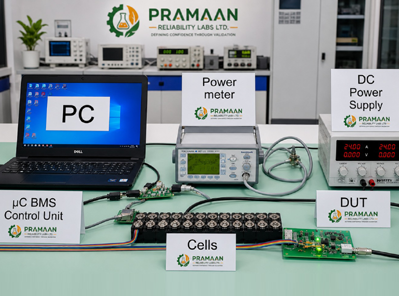
POWER INPUT:-
Power input testing determines the actual electrical power consumed by a product under defined operating conditions and compares it with the manufacturer’s declared rating.
Why it matters:
-
Prevents overheating and electrical hazards
-
Verifies product performance and design accuracy
-
Ensures compliance with national & international standards
-
Supports energy efficiency and regulatory approvals
High Voltage Testing:-
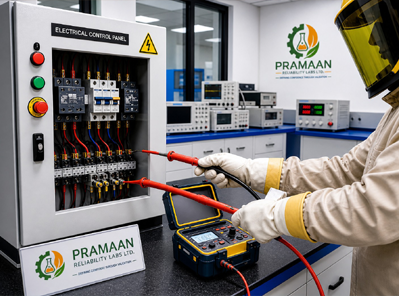
High Voltage Testing is performed to verify the dielectric strength and insulation integrity of electrical equipment by applying voltages higher than normal operating levels.
Purpose of HV Testing::
-
Detect insulation weaknesses
-
Prevent electrical failures and breakdowns
-
Ensure operator and equipment safety
-
Validate compliance with certification standards
Insulation Resistance Testing:-
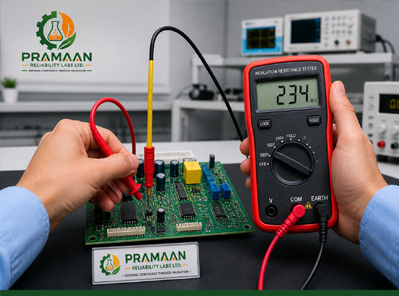
Insulation Resistance Testing measures the resistance offered by insulation materials between conductive parts by applying a DC voltage. It helps identify leakage paths, insulation deterioration, and potential electrical hazards.
Why IR Testing is Important:
-
Prevents electrical leakage and short circuits
-
Ensures user and equipment safety
-
Detects insulation degradation early
-
Supports product certification and compliance
Temperature Rise Testing:-
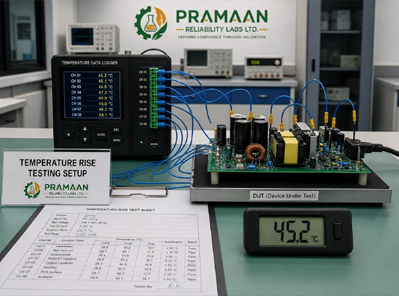
Temperature Rise Testing measures the increase in temperature of a product or its components when operated under specified conditions, compared to ambient temperature.
Why it matters:
-
Prevents overheating and fire hazards
-
Ensures insulation and material durability
-
Verifies safe operation under load
-
Supports compliance with certification standards
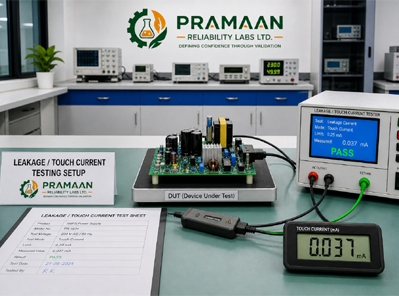
Leakage Current Testing:-
Leakage Current Testing measures the unintended flow of current from live parts of electrical equipment to accessible conductive parts or earth.
Why it matters:
-
Prevents electric shock hazards
-
Ensures user safety
-
Detects insulation weaknesses
-
Validates compliance with safety standards
RLC Measurement:-
RLC measurement determines the fundamental electrical parameters:
Resistance (R): Opposition to current flow
Inductance (L): Ability to store energy in a magnetic field
Capacitance (C): Ability to store energy in an electric field
Why it matters:
-
Ensures proper circuit functionality
-
Verifies component quality and tolerance
-
Supports design validation and troubleshooting
-
Essential for certification and performance testing